Showing posts with label Epistemology. Show all posts

Wednesday, 28 November 2012

Wittgenstein: belief, behaviour and beetles


The topic of today’s post is the meaning of mental-state terms, such as ‘belief’ and ‘desire.’ These terms are commonly used to refer, somewhat mysteriously, to strange things going on inside our heads. When a person says ‘I believe that it will rain tomorrow’, we take them to be referring to something intangible in the brain. Certainly, taking this view of beliefs and desires is useful in predicting human behaviour: philosophers call the use of such terms to predict and explain behaviour ‘folk psychology.’ This is all very well: but the interesting question is what these ‘folk-psychological’ terms actually mean. What is a belief? Is it a spooky new mental substance? Is it merely a combination of physical brain states in a particular combination at a particular moment? Or is it something else?

One really interesting answer to this question comes from Wittgenstein, who proposes a form of what has since been called ‘behaviourism.’ Wittgenstein’s philosophical behaviourism holds that ‘I believe X’ means ‘I am disposed to behave in a certain way given certain conditions’; and nothing more. All ‘a belief’ means is 'a tendency to do and say certain things given certain circumstances'. For example, if I believe that it is raining, all this means is that I display rain-like behaviour, such as putting up an umbrella, groaning about how I’m getting wet, etc. On this view, ‘belief’ is reduced radically to external, observable behaviour such as actions and sounds; ‘belief’ does not refer to anything going on inside my head, not even to a physical brain state or collection of brain processes. All it is to believe something (Wittgenstein and other behaviorists taught) is to be disposed to act in a certain way under certain conditions.

Why should we believe that this radical, externalist treatment of folk psychology is correct? Wittgenstein presented an interesting argument to show why: what has now been termed the ‘beetle in a box’ argument. In 'Philosophical Investigations', Wittgenstein imagines three people, each with a box in front of them that only they can look into (they can’t look into each others’ boxes). Each person looks into his/her box, and announces that inside their box, there is a ‘beetle.’ Wittgenstein points out that although the same word is being used to denote the contents of each box, there is no reason at all to think that each box contains the same object. The first person’s box could contain what we mean by beetle; the second person’s box could contain a fish; the third person’s box could contain nothing at all. We cannot know what is in each box, Wittgenstein points out, by merely listening to the word that each person uses to describe the contents of his/her box. Therefore, the word ‘beetle’ is meaningless when given meaning by a single person, and tells us nothing of what is within.

Wittgenstein’s main point is to show that all language is essentially public. There can be no such thing as a private language, because meaning is determined by public use, and in the beetle case, each person is employing his/her own unique use of ‘beetle.’ So too with words such as ‘belief’, ‘desire’, etc: using them to refer to private, intangible events going on inside peoples’ heads is meaningless, since the beliefs in your head are like a private language, only accessible to you, and nobody else. However, we know that ‘belief’ is a meaningful term; so, it must refer to something external and publicly verifiable: a behavioural disposition. (Whether Wittgenstein was a 'behaviourist' in a full sense is controversial, but we can take his reasoning here to provide a clear argument for behaviourism).

This conception of mental states such as belief is both very appealing and very counter-intuitive. It is appealing because it demystifies the mental; the mind can be given a much more plausible material explanation if beliefs and desires etc are no longer seen as intangible, ‘spooky’ occurrences inside our heads. However, the view is counter-intuitive because when we believe something, it seems obviously true that this is an inner mental event, something more interesting than a series of external behavioural patterns. Whether we accept Wittgenstein’s argument depends on how seriously we take what seems to go on in our stream of consciousness: how real is the internal nature of the mind? This question is absolutely central to the philosophy of mind, especially in questions about the phenomenon of consciousness, and the problems that arise from it.

Wednesday, 17 October 2012

Some thoughts about 'atheism', 'theism' and 'agnosticism'

It is common for people to describe themselves in relation to the question of the existence of God as 'atheist', 'theist' or 'agnostic'. Even before we get into the interminable debate as to whether there really is such a thing as God, I think there are a few things to be clarified in terms of how these labels are used. The following points are criticisms of what I take to be common assumptions concerning the use of the terms 'atheist', 'theist' and 'agnostic'.

'Atheist'
It is popular among self-confessed atheists to define atheism as ‘lack of belief in anything supernatural.’ This is handy for the atheist, since in the famous debate over where the burden of proof lies, it is a common argument to claim that the burden does not lie with the atheist, who has a mere lack of belief in God; rather, the burden is on the theist to give evidence for his / her positive assertion that there is a God. However, ‘lack of belief in God’ is a very bad definition of atheism, since it is true of rocks, camels and Christmas trees, which lack all beliefs, including about God. It would be an abuse of the word ‘atheism’ to refer to a rock as an atheist, so this definition clearly will not suffice. It is also insufficient for distinguishing atheists from agnostics, who also lack belief in God. Though it may suit the atheist in debate to characterize his / her position in terms of lack of belief, rather than a positive belief of the same type as theism, it is very hard to accurately do so. 'A belief that there is no God', which sounds more traditional, also sounds like a more accurate definition of 'atheism'.

'Theist'
There are so many uses of the word ‘God’ that the term is practically ambiguous. Restricting ‘theism’ to ‘Christian monotheism’ as is commonly done is too restrictive, since there exists monotheisms in many other cultures. The scale of religious conviction is a continuum, with very weak theisms positing the existence of a creating and sustaining ‘mother nature’ type force, and very strong theisms positing the existence of a single, powerful divine mind. Perhaps we might define theism as ‘belief in a creator and sustainer of the universe.’ However, this is too loose: belief in a scientific law (common to theists and non-theists alike) might well be held to fall under this definition. Should we then include creative intelligence in the definition of theism? No, since ‘intelligence’ is also ambiguous, and there are many theists who do not think of God as a giant, powerful disembodied mind (quite a crude conception), but something more abstract. 

'Agnostic'
Agnosticism, taken as an ‘I don’t know’ position, is commonly criticized as being too weak, a kind of cowardly middle-man position held by the person who lacks the conviction to commit to either atheism or theism. However, the strength of an intellectual position should not be judged on the content of the belief itself, but on the amount of assessment, deliberation and criticism that has been invested in that position, and the strength to which the belief is held. Therefore, one can be a very strong agnostic if, after deliberating long and hard and weighing up the evidence, one decides that we don’t know / can’t know enough to assent to God’s existence or reject God’s existence. It's clear that agnosticism can be as firm a positive belief about the world as atheism or theism. At the very least, an agnostic must have considered the question of God's existence, if only for a second.

'I don't care'
It is also widely held that ‘atheism’, ‘agnosticism’ and ‘theism’ (or ‘religious belief’ for the purposes of this point) exhaust the possibilities concerning intellectual attitudes about God. The question ‘are you atheist, theist or agnostic?’ implies that one must fit somewhere here, perhaps on a continuum between strong atheist and strong theist. Richard Dawkins, in 'The God Delusion', introduces a similar 7-point scale. However, this is simply false, since the three categories are not exhaustive. This is because, as argued above, agnosticism is a positive belief about the world, the agnostic having actively concluded that, based on the evidence, we simply don’t (or can’t) know if God exists or not, based on at least a shred of consideration of the question. Agnosticism does not, therefore, cover the sizeable group of people who haven’t for a minute considered the question of God at all: ‘I don’t know’ is not the same as ‘I don’t care.’ He / she who has not to any extent considered God’s existence will have no belief about God’s existence, and will have come to no conclusions; therefore, to label such a person ‘agnostic’, as is popular, would be false. This person has not joined the debate; therefore such labeling is not justified. Rather than create a new term for people who have never considered God’s existence (such as ‘I-don’t-care-ists’ or some more catchy name), it is more sensible, I think, to consider such people as located outside the continuum from atheist to theist. Therefore, the three categories ‘atheist’, ‘agnostic’ and ‘theist’ are not exhaustive, and should not be used as if they are: they describe only a sub-set of human beings.

Sunday, 6 May 2012

What is knowledge?


If knowledge isn't Justified True Belief, then what the hell is it?

Philosophers like to analyze concepts; that is, to take a concept and give conditions necessary and sufficient for that concept. For example, an analysis of ‘talking bullshit’ might go something like:

  • A person p is talking bullshit if and only if a) p says that a statement is true or false, and b) p does not know whether that statement is actually true or false, and c) p is indifferent to the truth or falsity of that statement. (Or something similar).

We can draw from this analysis that all it is to talk bullshit is to fulfill conditions a, b and c in the analysis. That is just what ‘to talk bullshit’ means in everyday language.

More interestingly, philosophers like to discuss knowledge, which has a few more strings attached. Ever since Plato, the widely-accepted analysis of knowledge in philosophy was the following:

  • A person p knows a proposition x if and only if a) p believes x, and b) p is justified in believing x, and c) x is true.

That, it was thought, is all it means to know something. If I know that I had breakfast this morning, all that means is that I have a ‘justified true belief’ that I had breakfast this morning. All it is to know that I had breakfast this morning is to fulfill conditions a, b and c in the above analysis, concerning breakfast.


However, Edmund Gettier, a little known American philosopher, wrote a 3 page article in which he demolished this long-held analysis of knowledge with such force that the ‘justified true belief’ model was instantly discredited by the philosophical community. He came up with an example to show that there are cases where a person could have a justified true belief, yet still they would not have knowledge in those cases:


“Suppose that Smith and Jones have applied for a certain job. And suppose that Smith has strong evidence for the following claim:

a. Jones is the man who will get the job, and Jones has ten coins in his pocket.

Smith's evidence for (a) might be that the president of the company assured him that Jones would in the end be selected, and that he, Smith, had counted the coins in Jones's pocket ten minutes ago. Proposition (a) entails:
b. The man who will get the job has ten coins in his pocket.

Let us suppose that Smith sees the entailment from (a) to (b), and accepts (b) on the grounds of (a), for which he has strong evidence. In this case, Smith is clearly justified in believing that (b) is true.” 

(Gettier, 'Is Justified True Belief Knowledge?'. Analysis 23 (1963), 121-123.)


However, as it turns out, Smith gets the job; the president has a sudden change of heart and decides to hire him instead of Jones. Furthermore, Smith too has ten coins in his pocket, which he had previously deposited there but had forgotten about.
What then, shall we say about this case? Well, Smith had a justified true belief that ‘the man who will get the job has ten coins in his pocket.’ It was true, as it turned out. Smith was justified in his belief as well, since he had it on good authority that a man with ten coins in his pocket would get the job (Jones). However, do we really want to say that Smith knew that ‘the man who will get the job has ten coins in his pocket?’. No, because his ‘knowledge’ turned out to be accidental. Therefore, knowledge is not justified true belief after all. Knowledge cannot be accidental - there must be something added to the analysis to rule out such accidental cases. As of 2012, philosophers are still looking for the answer.
Rarely in philosophy are there any really significant developments or widespread changes in thought. However in this case, it is undeniable that Gettier instigated one. Having published his paper in 1963, he has proceeded to sit back looking justifiably smug ever since, and as such has never published anything else, though he retains his status as Professor of Philosophy at the University of Massachusetts. Papers published: 1. Philosophical revolutions set in place: 1. That’s not a bad success rate.

Tuesday, 3 April 2012

Brains in vats

'Do you know? But do you REALLY know?'
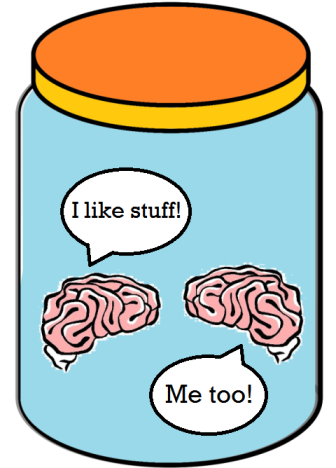
Descartes invites us to imagine a scenario where everything we have ever experienced, and continue to experience, is a simulation, controlled by an evil demon with an aim solely to deceive us. More recently, philosophers have spoken of ‘brains in vats’ - imagine that we are actually brains floating in vats, in the lab of an evil scientist who is feeding us thoughts and experiences.

Both these possibilities entail that the external world (i.e. what we generally take to be the world around us) is not real, and that our entire perspective on life is in fact a delusion. I say ‘possibilities’ because, though it may seem unlikely, there is nothing in our experience that shows these scenarios to be false. If we were all were brains in vats, then our world would look no different to how it would if we really existed in the real physical world.
We may scoff at the thought of taking seriously these possibilities, and this is an understandable response - after all, let’s be honest, we’re probably not actually brains in vats. But the fact that such a scenario is possible raises famous and much-repeated philosophical problems about knowledge, and our ability to know what really is the case. If I asked you, ‘do you know that the world around you is real?’, then you would undoubtedly reply ‘yes, of course.’ However, it seems plausible that in order to really know that the world is real, we must first rule out the possibility that we are actually brains-in-vats. And since, goes the argument, we have no way of ruling this possibility out for definite, we have no way of knowing that the world around us is real! The fact that the possibility seems unlikely is not enough to conclusively rule it out.

The so-called ‘problem of scepticism’ is a problem about knowledge of the world, not the existence of the world itself. There is probably no mad scientist. Let’s take for granted that the world is most likely real - this is uncontroversial. However, even if we do this, the fact that we cannot properly rule out the possibility that we are brains-in-vats seems to threaten our knowledge of the world. We WANT to claim that we know the things we generally take ourselves to know...but, the problem of scepticism suggests that we cannot claim this. And so, our knowledge of everything falls away.

Blog Directory
BLOG DIRECTORY, Submit blog free, Promote Blog, Best directory